
New ONS data finds AI affecting creative roles
5th August 2026
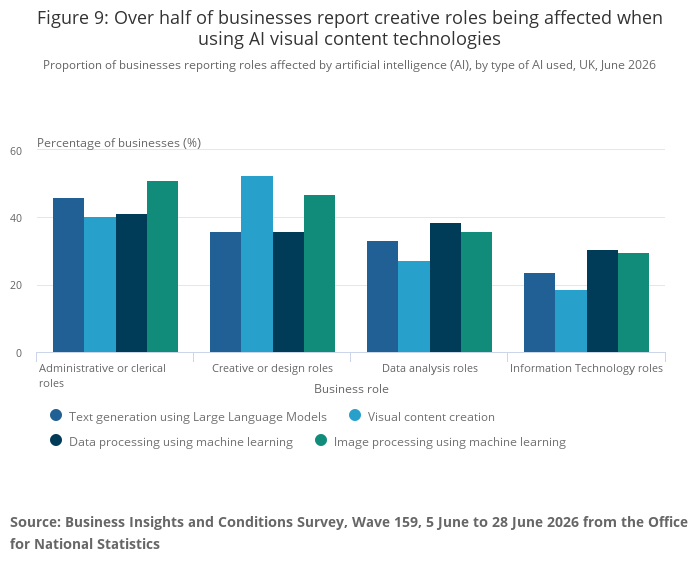
New data from the Office for National Statistics (ONS) shows that while AI has not reduced headcount in most businesses surveyed, creative and design roles are being affected.
The type of AI technology used by business appears to play an important role in shaping where the impacts on tasks and jobs are felt. For instance, over half of businesses using ‘visual content AI’ report an impact on creative and design roles. However the survey doesn’t reflect what this impact is exactly.
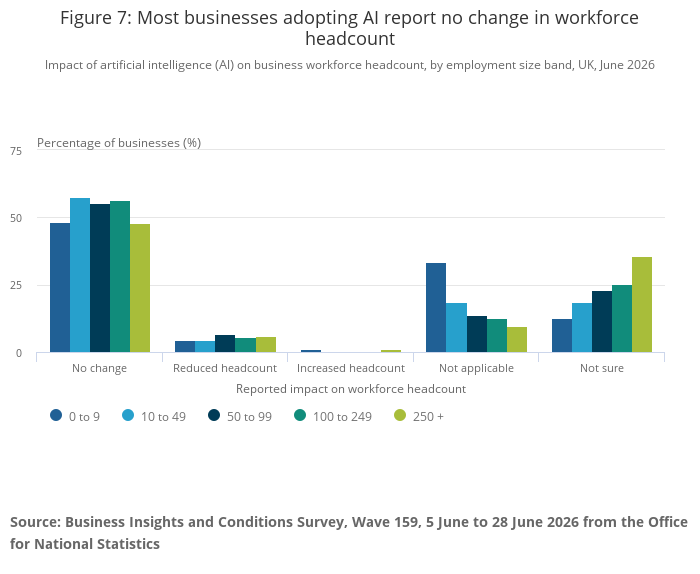
Most businesses did not report an impact on overall headcount as a result of AI (Fig. 7), but corporate ‘headcount’ does not usually include the self-employed freelancers they commission. This means the data may not reflect the true impact of AI on creators where they work as self-employed freelancers taking commissions. This is significant as around 1 in 3 workers in the creative industries are freelancers (self-employed), which is double the UK average. This figure rises to around 90% for musicians and illustrators.
In the absence of detailed national data on individual creators and AI, some trade associations and similar bodies in the creative industries conduct their own research.
2025 survey data from over 10,000 creative workers found a rapid and significant impact of AI on their work and their ability to earn a living. In terms of visual content, 32.4% of illustrators in a large-scale survey reported losing work commissions to generative AI. They are losing their bread and butter work, like book covers, concept art and marketing imagery (Association of Illustrators 2025).
The Association of Photographers’ (AOP) membership survey results (January 2026) support the ONS evidence: 58% of professional photographers are losing work to generative AI. They are competing for commissions which would otherwise have been solely produced by photographers and their production team. Additionally, 95% of AOP members said they were aware their photographic style can be replicated, which illustrates the need for a new Personality Right.
The UK Comics Creator Survey found that 36% of comics creators believe or know they have lost work or income due to generative AI. It is largely the smaller commissions that have disappeared for these creators: portraits, avatars, character design, book covers, event posters, logos, band artwork - the types of jobs which keep them afloat.
The ONS research revealed that 16% of businesses were using visual content AI in June 2026. Large language models (LLMs) were the most widely used among businesses (18%).
When asked about the key factors preventing or delaying AI adoption, businesses most commonly cited AI expertise, followed by cost and difficulty finding business use cases. Only a very small proportion cited employee concern about the impact of AI, or concerns about government regulations.
The CRA will continue to monitor robust evidence and insight about the impact of generative AI on individual creators, and use this in our advocacy efforts.
If you have relevant research we can reference, please do reach out: contact@creatorsrightsalliance.org